These pages document the implementation of ALPACA. We’ll see what ALPACA computes, discuss how it computes this, and step through a typical run to name some code modules as they are used. An index to more complete documentation of individual source files is given at the end.
ALPACA is an analysis tool that determines, for some program and some property-to-be-checked, all the program paths that must or may satisfy the property. (Must information guarantees reachability; may information overapproximates and could introduce false positives.) These program paths are expressed as logical formulae constraining the values of program inputs. For example, consider trying to determine the constraints on x and y that lead to reaching an error() call in the following C program.
main() {
  int x=input(); int y=input();

  if (x<0) {
    error();
  } else if ((x>9) && (x<y*y)) {
    error();
  }
}
We see that an error() can be reached in two ways: if \(x<0\), or if \(x>9 \land x<y*y\); and all inputs that do not satisfy these constraints will avoid any error(). ALPACA runs a host of tools that look for reachability or unreachability proofs. If the underlying tools can determine the two reachability constraints described above as well as provide an unreachability proof in the remainder of the program (i.e., inputs not satisfying the two constraints), then ALPACA will return this exact description.
However, determining that all inputs outside of these constraints do not lead to an error() may be difficult for an automated static analysis due to the nonlinear constraint \(x<y*y\). In this case, we may try relaxing the constraint of \(x>9 \land x<y*y\) to be simply \(x>9\). With the nonlinearity removed, the static analyses can prove that inputs outside of \(x<0 \lor x>9\) will not lead to an error(), and the description of program paths returned by ALPACA becomes slightly more approximate: an error() must be reached if \(x<0\), or if \(x>9 \land x<y*y\), and may be reached if \(x>9\); everything not implied by these formulae will avoid the error().
This mix of must and may characterizations is computed using the alternating conditional analysis framework, described next.
ALPACA is an instantiation of the Alternating Conditional Analysis (ACA) framework. ACA builds upon ideas from conditional model checking (Beyer et al. 2012) and alternation between may and must pieces of information returned by an analysis (Godefroid et al. 2010).
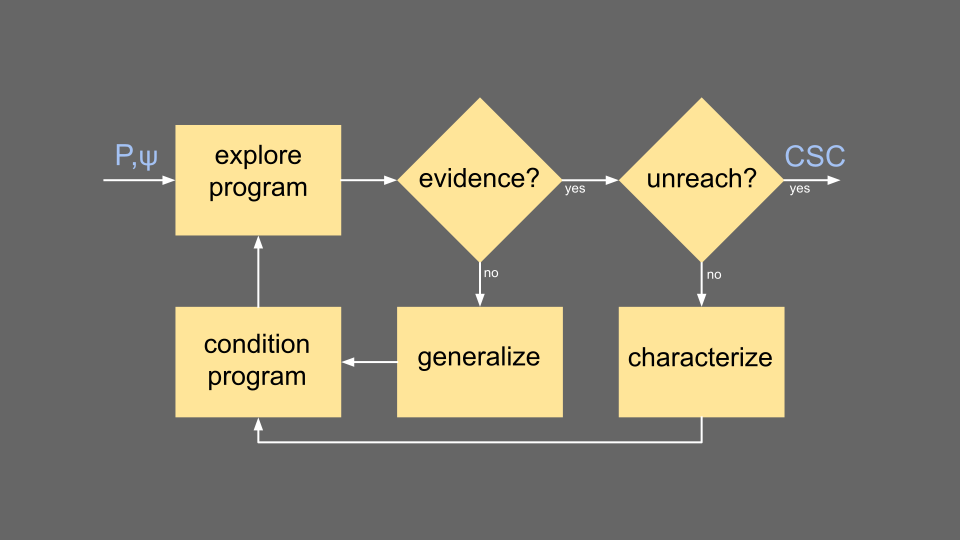
ACA takes as input a program and a property, and returns a logical characterization that relates the property’s reachability to all program states. We call this structure a comprehensive state characterization, or a CSC. ACA iteratively collects this logical description by running multiple analysis tools to explore the program in parallel, characterizing their results, and blocking (i.e., conditioning away from) already-seen paths until all of the paths have been accounted for. In order to reach a fixed point, if no new evidence is found, there is a generalization phase that “widens” the CSC, i.e., relaxes some must constraints to may constraints. The terminating condition is when some overapproximating tool reports unreachability in the thus-uncovered portion of the program. The flow diagram for ACA is given below.
The above flow diagram is directly reflected in its implementation within ALPACA. Below is the recursive aca function within Analysis.lhs. (The assumed property is to check for the reachability of a __VERIFIER_error() call.)
aca :: Program -> Csc -> AcaComputation Csc
aca program csc = do
  result <- exploreSubspace program csc
  case result of
    UnreachableEvidence -> do
      csc' <- enforceDisjointness csc
      lastWrites csc'
      return csc'
    (ReachableEvidence ev) -> do
      csc' <- characterize ev
      program' <- condition program csc'
      aca program' csc'
    NoEvidence -> do
      csc' <- generalize csc
      program' <- condition program csc'
aca program' csc'To get a rough feel of how the code is executed during a typical run of ALPACA, let’s step through a simulated run at a high level.
When running alpaca --portfolio cpaSeq,cbmc foo.c on the following simple C program:
int main() {
  int x=input();
  if (x<0) { error(); }
}./logs_alpaca/foo/; this is where conditioned programs, tool results, and logs about each iteration will be written torunAca within Analysis, and the core logic can now be launched from aca within the same fileexploreSubspace within Analysis, which uses functions defined in RunPortfolio and LaunchBenchexec.Csc) defined in CscTypesfoo.c is instrumented to block the input space accounted for in the CSC by adding assume(!(x<0)); using code from Transformations and Transformeraca; this time CPA-Seq declares that the remainder of the program cannot reach the error() statement, which is ACA’s termination conditionNote that this step-through is not at all exhaustive: it does not cover the case when ACA requires generalization (which invokes code within Characterize and BinarySearch), does not discuss all configuration options (shown with alpaca -h), does not list each created artifact, does not name each code module used, etc. For more details, refer to the documentation in the individual source files, linked below.
The entrypoint of the program is Main, the high-level logic is in Analysis, and the rest is here: